

Action Learning Gets A Facelift
Why Reg Revans may hold the key to unlocking the AI revolution

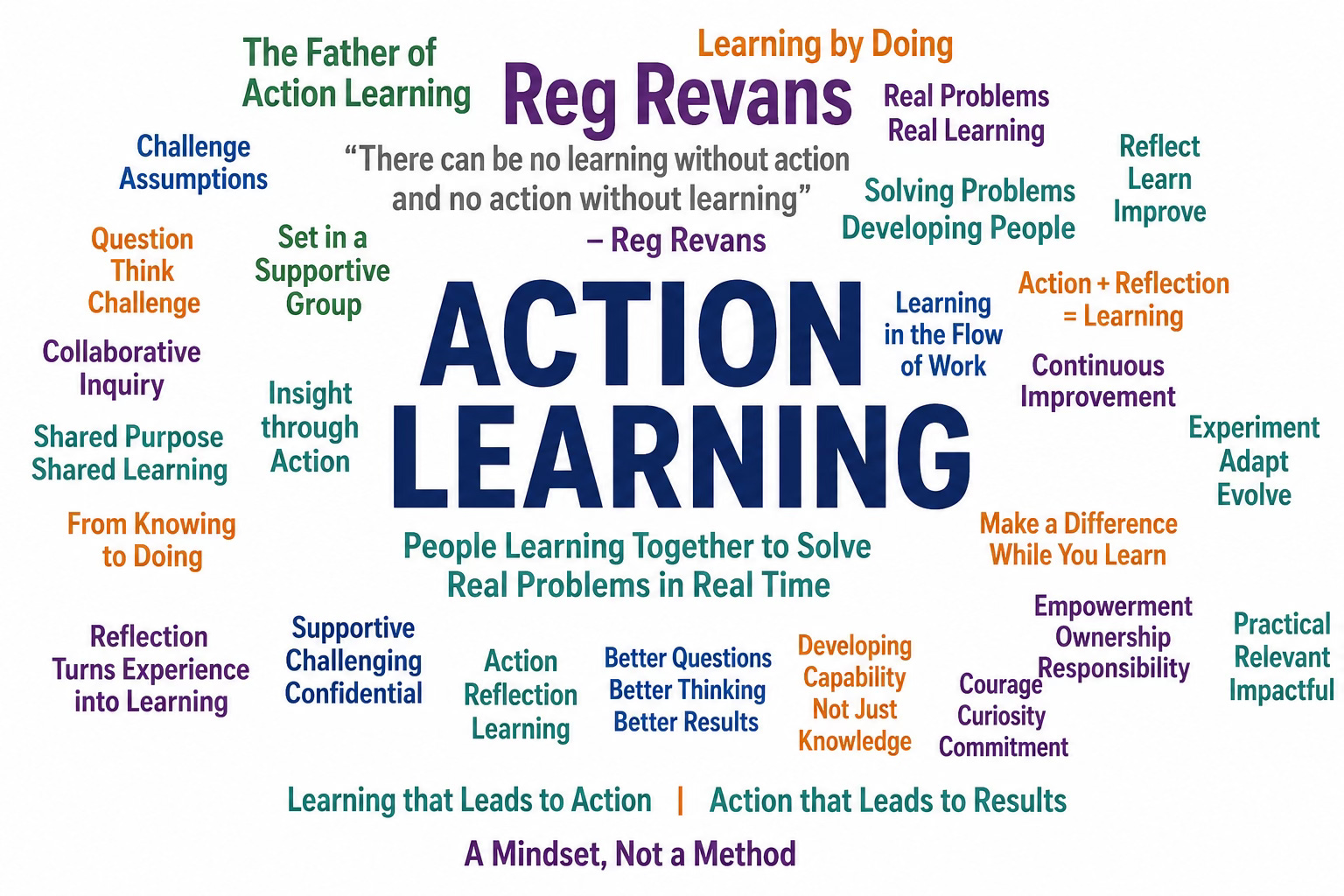
Everywhere you look, people are talking about Artificial Intelligence. Governments are investing billions. Organisations are redesigning their workforce. Consultants are promising productivity gains and technology companies are predicting transformation at unprecedented scale.
Yet there is one question almost nobody seems to be asking.
What happens after AI gives you the answer? Because that is where the real work begins.
AI can do so much;
Generate ideas.
Analyse data.
Summarise research.
Write plans.
Challenge assumptions.
But it cannot implement change or lead people to achieve deeper insights. It can’t navigate politics or build trust and it certainly can’t take responsibility for decisions.
In other words, it cannot turn information into organisational capability. Only people can do that.
Which is why I believe the ideas of Reg Revans and Action Learning are becoming more important, not less, in the age of AI. In many ways, Revans was solving a problem that has now become one of the defining challenges of our time.
How do we turn knowledge into action?
Today, that challenge has become even more urgent because knowledge is no longer scarce. In fact, it is abundant and that brings a different challenge, that abundance creates complacency.
We can now generate a strategy in minutes, create a business plan in seconds or draft a report before we’ve finished our coffee. The temptation is to confuse speed with progress and it isn’t.
A strategic plan has no value until somebody acts on it.
A brilliant idea has no value until somebody tests it.
A recommendation has no value until somebody implements it.
The future will not belong to those with access to the best AI but to those who combine AI with disciplined execution.
This is where Action Learning needs a facelift.
Not because the principles are wrong but because the context has changed.
The original Action Learning model focused on groups of people working together to solve real organisational problems while learning from the process. That principle remains sound.
What changes is the toolkit.
Today’s Action Learning environment looks very different.
Imagine a team trying to improve customer experience. Twenty years ago they might spend weeks gathering information.
Today AI can produce:
Customer analysis
Market research summaries
Competitor insights
Improvement options
Draft implementation plans
Within minutes, the technology is remarkable BUT that is not the learning.
The learning begins when the team asks:
What should we actually do?
What assumptions need testing?
What are we missing?
How do we implement this?
What resistance will we face?
What happens if it fails?
How do we adapt?
The learning occurs in the action taken not in the information gathered.
In reality, AI may make Action Learning more valuable than ever because it removes many of the administrative barriers that previously slowed learning down.
Teams can spend less time collecting information and more time applying judgement.
Less time producing reports and more time solving problems.
Less time analysing yesterday and more time creating tomorrow.
This is Action Learning 2.0.
Not learning and then doing but learning through doing.
Supported and accelerated by AI but never replaced by it.
The implications are enormous.
For business, it means moving beyond training programmes towards live commercial challenges.
Instead of attending a course on sales, a live experiment to improve sales.
Instead of attending a course on innovation, launch something new and testing the response you get.
Instead of attending a course on leadership, leading a difficult project with coaching/mentoring reflection. For public services like the NHS or Social Care, it means developing capability through improvement initiatives rather than classroom learning. For education, it means preparing people to solve problems rather than simply pass examinations.
And for leaders, it means creating cultures where experimentation becomes normal because there is another truth emerging. The organisations that gain the greatest return from AI will not necessarily be those with the most sophisticated technology. They will be those with the strongest learning cultures.
In my book about Learning Organisations I make it clear that the culture of experimentation and curiosity are the ones that enable growth and innovation and the ones who punish experimentation and blame when things go wrong are condemned to stagnation.
The ability to learn, adapt and implement quickly will become the defining competitive advantage of the next decade.
Not technology but improved capability.
Not knowledge but practical application.
Not information for its own sake but genuine action.
Perhaps that is why Reg Revans feels so modern. At a time when the world is obsessed with answers, he reminds us that answers are only the beginning.
The real learning starts when we decide to do something with them and that may be the single biggest lesson organisations need to learn if they genuinely want the productivity gains and return on investment that AI promises.
Because AI can generate a thousand possibilities but only action can generate results.